
Bactericidal ultraviolet light in the Soviet Union: a comprehensive history
Creation: Claude-4.6, edits by Vlad Chupakhin

I was born in the USSR and remember those blue disinfection lights that were standard in nearly every medical office — and quite common even in ordinary school classrooms. Years later, during a biosecurity course, I came across the concept of UV-C as a default measure for pandemic preparedness. I started reading some Russian sources on the topic, because English one was limited. So, let’s fix this.
Intro
The USSR built the world’s most extensive national infrastructure for UV-C germicidal irradiation, deploying bactericidal lamps in virtually every hospital, kindergarten, factory, and sanatorium across its territory from the 1950s onward. While Soviet scientists entered the field roughly two decades after their American and German counterparts, centralized public health policy, industrial capacity, and ideological alignment transformed UV-C technology from a niche Western innovation into a pillar of Soviet preventive medicine. That legacy persists: Russia today mandates UV-C disinfection in healthcare settings, operates some of the world’s largest UV water treatment plants, and maintains a regulatory framework unmatched in its specificity. The Soviet UV-C story is one of applied deployment at scale rather than fundamental discovery — and it offers lessons for global infection control that the COVID-19 pandemic brought sharply into focus.
Before the Soviet program: Western foundations and early Russian contributions
The germicidal properties of ultraviolet radiation were first demonstrated by Downes and Blunt in 1877, and Robert Koch confirmed UV’s ability to kill Mycobacterium tuberculosis in the 1890s. Niels Finsen’s 1903 Nobel Prize for UV treatment of lupus tuberculosis spurred global interest, and the first mercury-quartz lamp appeared in 1904. By the 1930s, American researchers William F. Wells and Richard L. Riley had established the theoretical framework for airborne infection control via UV, and low-pressure mercury discharge lamps emitting primarily at 253.7 nm — the wavelength closely matching DNA’s peak absorption — were commercially available in the United States and Germany.
Russia’s contribution during this early period was modest but notable. The scientist A.N. Maklakov conducted research on the effect of different spectral regions on microflora, establishing that UV radiation at 200–295 nm possesses disinfecting properties with maximum bactericidal effectiveness at 260–265 nm. This work, referenced in a 2023 monograph by VNIMI (the Russian Scientific Research Institute of the Dairy Industry), represents one of the earliest documented Russian contributions to UV germicidal science. However, the turbulence of revolution, civil war, and Stalinist consolidation delayed systematic Soviet engagement with UV-C technology until the postwar period.
The Great Soviet Encyclopedia’s entry on bactericidal lamps defined them as “gas-discharge mercury lamps of low pressure, power 15–30W, with a tube of uviol glass, used for disinfection by ultraviolet rays of air in premises and objects.” By that point, Soviet adoption was already two decades old — but the entry’s very existence in the nation’s authoritative reference work signals how thoroughly UV-C had been absorbed into Soviet scientific culture.
The 1950s deployment wave and the infrastructure of mass irradiation
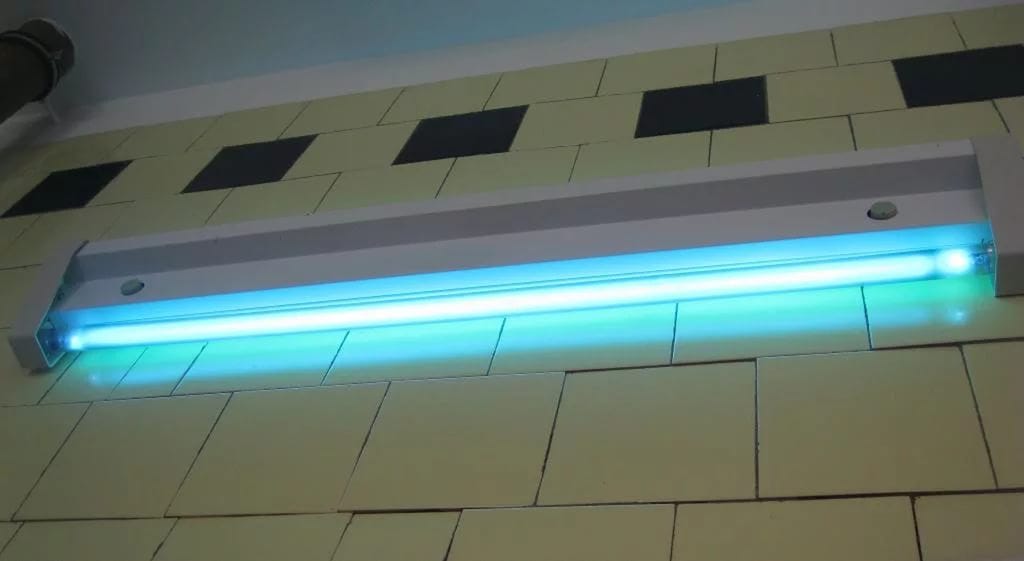
Soviet adoption of UV-C bactericidal technology began in earnest in the 1950s, catalyzed by a 1949 Council of Ministers decree (No. 1416) that established the Saransk Electric Lamp Factory — later the nucleus of the USSR’s largest lighting enterprise. By 1956 the factory was producing lamps, and by 1964 it had expanded into the Saransk Production Association “Svetotekhnika” (СПО «Светотехника»), incorporating multiple factories and research institutes. This industrial base enabled mass production of the БУВ (BUV) series of bactericidal lamps — standing for “Бактерицидная Увиолевая” (Bactericidal Uviol). The БУВ-15 and БУВ-30 became workhorses of Soviet germicidal irradiation, constructed from uviol glass that transmitted the germicidal 253.7 nm mercury emission line while partially blocking the ozone-generating 185 nm line.
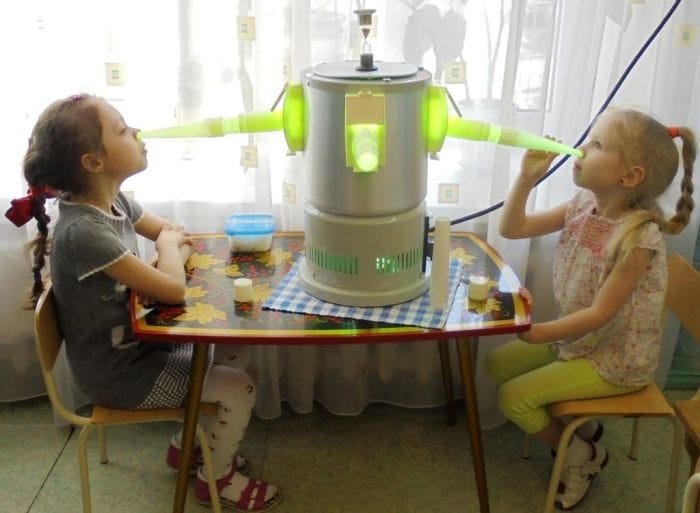
The scope of deployment was extraordinary. UV irradiation of children for rickets prevention became standard in every kindergarten — children wearing dark protective goggles gathered around quartz lamps in scenes documented by National Geographic in settlements like Lovozero. The “Solnyshko” (Солнышко, “Little Sun”) device, with nozzles for throat, nose, and ears, was ubiquitous in polyclinics. Soviet adoption of physiotherapy technologies was unmatched globally in scale.
Factories constructed dedicated UV rooms called “fotarii” (фотарии), where workers rode 40-meter conveyor belts between rows of mercury-quartz lamps to ensure uniform UV dosing. These installations served coal mines, metallurgical plants, vocational schools, and gymnasiums, particularly in northern regions where long, dark winters created severe UV deficiency. In the 1970s and 1980s, erythemic luminescent lamps were deployed in dedicated fotarii for miners and Arctic workers.
Hospitals adopted whole-room UV germicidal irradiation (UVGI) as standard practice, with wall-mounted fixtures in patient rooms, corridors, operating theaters, procedure rooms, ICUs, and even physician offices. Blood transfusion stations and bacteriological laboratories were routinely equipped. Soviet space medicine researchers — including O.G. Gazenko, Yu.E. Nefedov, and N.E. Panferova — integrated UV bactericidal and prophylactic irradiation into the practice of space flights, publishing findings in Kosmicheskaya Biologiya i Aviakosmicheskaya Meditsina (Space Biology and Aerospace Medicine) through the 1980s.
Key researchers and the institutional architecture of Soviet UV-C science
Soviet UV-C research was distributed across a network of specialized institutes, each contributing distinct expertise. NII Dezinfektologii (the Research Institute of Disinfectology) under the Ministry of Health served as the central node for standards development. Its lead figure, M.G. Shandala — an Academician of the Russian Academy of Medical Sciences — spearheaded both the 1995 and 2004 regulatory guidelines that remain foundational to Russian UV-C practice. His collaborator V.G. Yuzbashev co-authored the 2003 monograph UV Radiation in Prevention of Infectious Diseases (Moscow: Medicina, 204 pp.), the principal Russian-language reference on the subject
Alexander Lvovich Vasserman, a graduate of the electrophysics faculty of VZEI (1957) and an Honored Machine Builder of the Russian Federation, spent his career at NII ZENIT developing the engineering side of UV-C technology. A prolific author in the journal Svetotekhnika (Light Engineering) — the premier Russian publication for UV-C research — Vasserman’s work spanned decades and included both theoretical and applied contributions to bactericidal irradiation system design.
Other key contributors included G.N. Rohklin, whose 1991 book Gas-Discharge Light Sources (Energoatomizdat) became the definitive Soviet reference on lamp physics including bactericidal lamps; A.B. Matveev, S.M. Lebedkova, and V.I. Petrov at the Moscow Power Engineering Institute (MEI), who published Electric Irradiators of Photobiological Action in 1989; and G.S. Sarychev, who contributed calculation methods for bactericidal installations in Svetotekhnika.
The institutional landscape included:
VNIIIS im. Lodygina (Saransk) and VNISI (Moscow) — the two leading Soviet lighting research institutes
NII of Human Ecology and Environmental Hygiene named after A.N. Sysin (Academy of Medical Sciences)
VNII of Medical Instrumentation (VITA) — contributed to UV equipment standards
NPO named after S.A. Lavochkin — the aerospace enterprise that patented the first Russian closed-type UV air recirculator in 1994
SKB Xenon (Zelenograd) — developed xenon-based UV systems
Lamp technology and irradiator designs: the ДБ and ОБН families
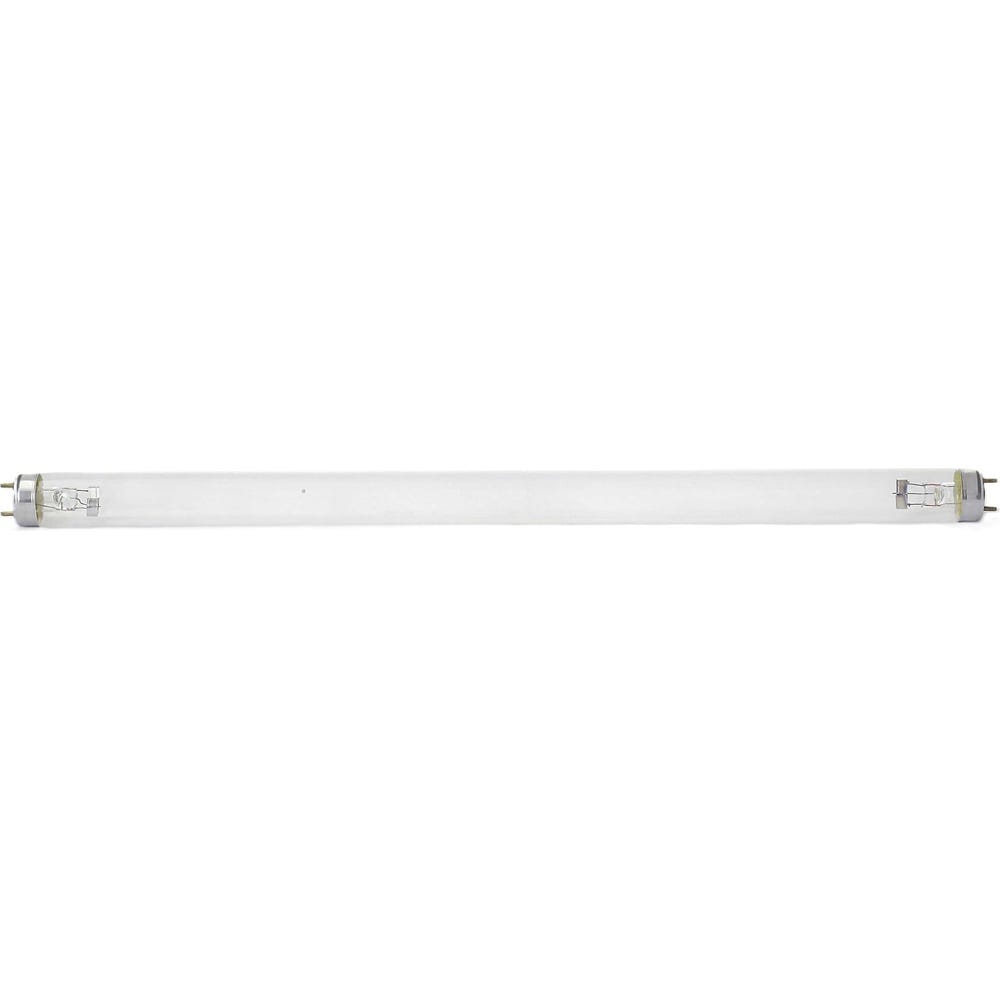
Soviet UV-C hardware evolved through two major naming conventions. The original БУВ designation gave way in the 1970s to the ДБ (DB) series — “Дуговая Бактерицидная” (Arc Bactericidal). The product line eventually encompassed models from ДБ-4 through ДБ-300, with the ДБ-30 serving as the standard model: 30 watts, 10.0W bactericidal UV flux, T8 form factor, G13 bi-pin base, 908.8 mm length, 9,000-hour service life, emitting at 253.7 nm. The higher-end ДБ-300 introduced amalgam technology — a significant innovation providing stable UV output across a 5°C–50°C temperature range, with 87W of UV flux from 270W input power and a 12,000-hour service life.
Irradiator fixtures (the housings that held lamps and directed UV output) followed their own classification system. ОБН (Облучатель Бактерицидный Настенный) designated wall-mounted units, ranging from the single-lamp ОБН-35 to the ОБН-150 with dual 30W lamps offering three operating modes — open, screened, or combined. ОБП (mobile or ceiling-mounted) units scaled from the ОБП-150 to the six-lamp ОБП-450, which processed 360–840 m³/h at bactericidal efficiencies of 95–99.9% and featured a 10-second delayed ignition to allow personnel to exit.
A pivotal innovation came in 1994 when the design bureau of NPO im. S.A. Lavochkina — a prestigious Soviet aerospace enterprise — patented the first domestic recirculator: a closed-type UV irradiator that disinfected air drawn through an internal chamber, making continuous operation safe in occupied rooms. This addressed the fundamental limitation of open Soviet UV fixtures, which required room evacuation during use. Modern Russian recirculators like the Dezar series (KRONT company) descend directly from this lineage.
Specialized variants included ДБК (quartz-glass bactericidal lamps), ДРБ (high-pressure mercury bactericidal lamps), and the ОЭП mobile erythemic irradiator with nine erythemic lamps and two 300W incandescent heating lamps for group prophylactic UV exposure.
A layered regulatory framework: from GOST to SanPiN
The Soviet and post-Soviet regulatory structure for UV-C irradiation is remarkably detailed, organized across multiple tiers of authority. No single GOST standard governs bactericidal lamps exclusively; instead, requirements emerge from interlocking medical equipment, metrology, and safety standards combined with Ministry of Health guidelines.
СН 4557-88 (1988) represents the key Soviet-era occupational safety standard, establishing permissible UV irradiance levels across three spectral bands. For short exposures under 5 minutes, limits were set at 5,000 μW/cm² for UV-A and 5 μW/cm² for UV-B; for sustained exposure exceeding 50% of a work shift, UV-B was capped at 1 μW/cm². Supporting GOST standards governed UV measurement instruments (ГОСТ 8.552-86), lamp spectral characterization (ГОСТ 23198-78), and medical equipment electrical safety (ГОСТ 12.2.025-76).
The operational heart of the regulatory framework, however, lies in the Ministry of Health guidelines. The first Soviet document on bactericidal lamp application dates to approximately the early 1950s — referenced but not fully identified in later guidelines. The modern regulatory chain includes:
МУ 5046-89 (1989): “Preventive UV irradiation of people using artificial UV sources” — a late-Soviet guideline
МУ 11-16/03-06 (1995): Updated guidelines for bactericidal lamp application, developed by Shandala, Yuzbashev, and Vasserman
Р 3.1.683-98 (1998): Intermediate guideline on UV bactericidal disinfection
Р 3.5.1904-04 (2004): The principal regulatory document for two decades, specifying a 0.001 W/m² maximum bactericidal irradiance in occupied zones, ozone monitoring no less than once per 10 days, and detailed dose tables for specific pathogens
СанПиН 2.1.3.2630-10 (2010): Mandatory sanitary requirements for medical organizations, requiring UV bactericidal air disinfection calculated per Р 3.5.1904-04
Р 3.5.1.4025-24 (2024): The current replacement guideline
The food industry received its own specialized guidance in МУ 2.3.975-00, covering UV deployment in bakeries, dairy processing, breweries, cold storage, and food packaging — applications including conveyor-line UV irradiation of bottles and containers before filling.
Tuberculosis control and the Vladimir model
UV-C’s role in Soviet and post-Soviet tuberculosis control represents one of the most significant applications of germicidal irradiation anywhere in the world. Russian national regulations mandate whole-room UVGI in aseptic areas of surgical and infectious disease departments, requiring 2–3 treatments daily, minimum 45 minutes each, with rooms unoccupied during open-lamp operation.
The Vladimir* Regional TB Control Center became a landmark facility when it introduced upper-room UVGI in 2003, supported by US CDC researcher Dr. Paul A. Jensen. The center was designated a “center of excellence” for TB infection prevention and control in 2007. Its director, Dr. Grigory Volchenkov, oversaw the installation of over 240 UV-C fixtures across 6,000 m² — approximately one fixture per 18 m². The Vladimir design featured dual-lamp wall fixtures: the upper lamp operated 24 hours a day, 7 days a week for continuous upper-room UVGI safe for occupants, while the lower lamp activated for whole-room disinfection during unoccupied periods. Adjustable baffles allowed UV distribution to be customized to room geometry. *Vladimir is a name of the large regional city.
An unpublished but widely cited study by Volchenkov and Jensen found upper-room UVGI to be far less expensive per year per equivalent air changes per hour (ACH) compared to mechanical ventilation or commercial air cleaners. Harvard’s Edward Nardell — the leading Western authority on UVGI — cited this Russian experience in his 2021 papers arguing that upper-room UV was the most effective, evidence-based, cost-effective, safe and available engineering intervention to disinfect air. During COVID-19, Volchenkov reported that hospitals without upper-room UVGI experienced high SARS-CoV-2 transmission among staff, while facilities with it fared better. The Vladimir model subsequently expanded across multiple Russian regions (Orel, Karelia, Khabarovsk) and former Soviet states including Belarus, Ukraine, Tajikistan, Kyrgyzstan, and Kazakhstan.
Why the Soviet path diverged from the West
The contrast between Soviet and Western approaches to UV-C is striking and multi-causal. A 2013 analysis in the Journal of the Royal Society of Medicine by Kühlbrandt and McKee identified several reinforcing factors. The scientific-philosophical divide was fundamental: Western medicine embraced Popperian falsification and randomized controlled trials championed by Archie Cochrane, while Soviet medicine followed a more inductive approach that gathered supportive evidence rather than seeking to refute hypotheses. Evidence-based medicine, as the West understood it, failed to be adopted in the Soviet Union.
Ideological alignment played a real role. Lenin’s dictum that “Communism is Soviet power plus the electrification of the entire country” made UV technology — high-tech, egalitarian, deliverable to the masses — ideologically attractive. UV lamp production aligned with Soviet heavy industrial capacity, while the USSR never developed the capacity to produce innovative pharmacological products and could not reliably distribute pharmaceuticals across its vast territory. UV hardware was a practical substitute. When antibiotics arrived in the West in the 1940s–1960s, they displaced UVGI from infection control strategies. In the Soviet Union, where antibiotic distribution was uneven, UV remained essential.
Russia’s extreme TB burden — including some of the world’s highest rates of multi-drug-resistant tuberculosis — created a persistent need for environmental infection controls that Western countries, with their lower TB rates, did not face. The regulatory framework institutionalized this divergence: Soviet/Russian authorities mandated UVGI in healthcare settings, while the US CDC merely recommended it for high-risk facilities like TB isolation rooms and homeless shelters. Finally, scientific isolation from international literature meant that when Western researchers moved away from UVGI in the 1960s–1980s, Soviet practitioners were largely unaware of — or unaffected by — the shift.
Water treatment, food safety, and the rise of NPO LIT
Soviet UV-C applications extended well beyond air disinfection. NPO LIT, founded in 1991 by graduates of the Moscow Institute of Physics and Technology (MIPT), grew from Soviet-era expertise into one of the world’s top three UV disinfection system manufacturers. The company developed proprietary amalgam UV lamps — producing up to 600W from low-pressure high-output designs — that deliver 3–4 times the UV power of standard mercury lamps with stable output across wide temperature ranges. With 360+ employees, production centers in Moscow and Erfurt, Germany, and subsidiaries across six countries, NPO LIT has completed over 6,000 installations worldwide.
The company’s signature achievements include the UV systems at Moscow’s two major wastewater treatment plants: Kuryanovskiye (3.125 million m³/day, the world’s largest UV disinfection plant at commissioning in 2012) and Lyuberetskiye (1.35 million m³/day, operational since 2008). Together, these systems mean 100% of Moscow’s daily water — over 6 million m³ — is now UV-disinfected. St. Petersburg’s drinking water system, commissioned in 2005–2006, ranks among the world’s largest UV drinking water installations at 1.26 million m³/day. International installations include a 780,000 m³/day underground wastewater plant in Beijing — Asia’s largest — plus systems in Berlin and Vienna.
In the food industry, ДБ-series lamps were explicitly designated for prevention of microbial contamination of food products, equipment and containers. Applications included UV irradiation of bread and pastries to prevent mold during cooling, disinfection of dairy bottles and carton containers before filling, cold storage air disinfection, and conveyor-line UV treatment of packaging materials. Russian scientists also presented an innovative combined ultrasound-plus-UV water treatment technology at the 2003 International UV Technologies Congress in Vienna.
Conclusion
The Soviet UV-C story challenges the assumption that fundamental scientific discovery and practical public health impact necessarily travel together. Soviet contributions to UV-C science were incremental, not foundational — the action spectrum, droplet nuclei theory, and upper-room UVGI concept all originated in the West. Yet the USSR achieved something the West did not: the systematic, nationwide integration of germicidal irradiation into everyday public health infrastructure, sustained across decades and embedded in mandatory regulations.
Three insights emerge from this history. First, regulatory mandates drive adoption far more effectively than scientific evidence alone — the Soviet requirement for UVGI in healthcare settings created a deployment density that voluntary Western guidelines never matched. Second, industrial policy shapes medical technology — the USSR’s strength in lamp manufacturing and weakness in pharmaceutical production channeled infection control toward hardware solutions. Third, the Soviet experience now serves as the world’s largest natural experiment in sustained UVGI deployment, and its documentation by researchers like Volchenkov and Nardell has become newly relevant in an era of airborne pandemic threats. The irony is pointed: a technology that the West largely dismissed for half a century survived in a system often criticized for scientific rigidity, only to be rediscovered when COVID-19 forced a global reckoning with airborne disease transmission.